Pages

Tuesday, July 24, 2012

COG (Climb of Girth)

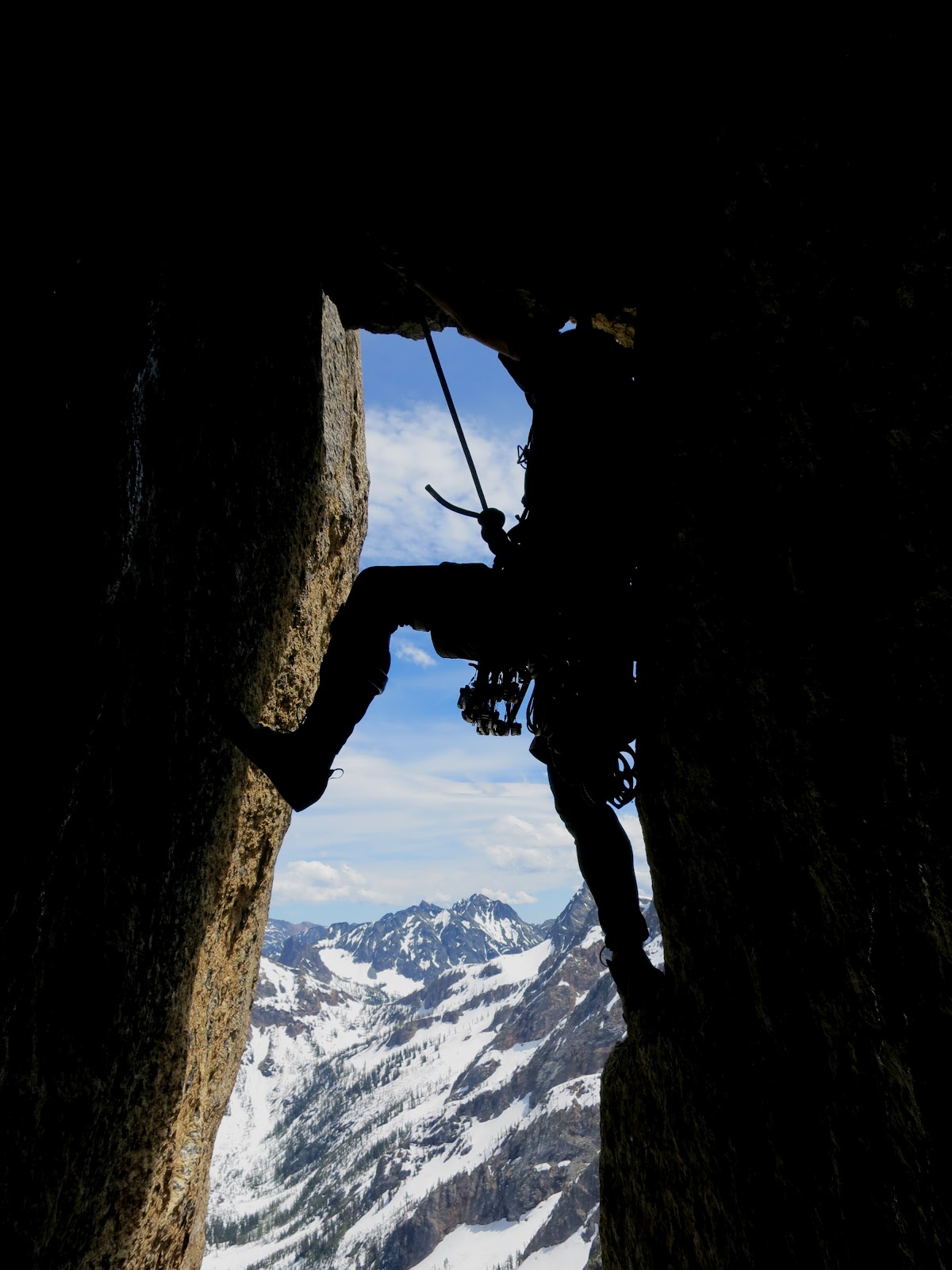
Until recently I have been unaware of the latest entry into the climber's vernacular:  MOG.  For those of you not learned in climber speak, a MOG is a man of girth... we'll apparently this last weekend was a COG (climb of girth).  Colin and I teamed up for the Girth Pillar and had a great if not adventurous time.  We made good time throughout our climb even considering the two pairs of boots, axes and crampons that the follower was force to carry.
There isn't any section on this route that is amazing but the entire package makes it worth climbing.  Many (most?) people seem to approach via the N Ridge bypass which makes it a considerably shorter climb and easier due to lack of ice climbing terrain and required gear.  I'm glad we climbed it via the Ice Cliff Glacier but it was a lot of work.  We encountered three pitches on the Ice Cliff that we felt were belay worthy, but if you had two tools you likely would just solo through (but then you have to carry two tools).
Our excitement factor was multiplied by a surprisingly active Ice Cliff Glacier and a rock fall incident that destroyed one backpack and put two core shots in our lead line.  Misadventures aside we rallied and finished the climb in good time and were still friends at the end of the story.


Climbing down low on the L to R leading ramp to the Girth Pillar

Colin jugging up to our hanging belay on the Girth Pillar

Me leading the 5.11 section on the second pitch


Thursday, July 19, 2012

Adventures in Meth-opotamia

The climbing at the Index Town Walls is perhaps the biggest draw to the Sky Valley aside from the meth cookers.  The climbing can get you just as high... without all those bugs crawling under your skin.

Jason and I ran out for an after-work session up at the upper town wall.  It had been about ten years since I'd been on Heaven's Gate which is a fantastic sport multipitch line about fifty yards left of Davis-Holland.  There isn't a bad section on this route and developers bolted it very well (albeit a tad conservatively in some sections).  Bring 14 draws, leave the trad rack hanging at the first belay and a single 70m rope will get you up and down.  In my mind this route is on par with Davis-Holland an ought to have a line at the bottom.  

Jason climbing Lamplighter (Heaven's Gate's first pitch).

Jason nearing the top of the second pitch.

Jason on the third pitch.  The route finishes up the obvious
double roofs above with a definite crux at the second roof.

Sunday, July 01, 2012

Come to Washington Pass for the Crack

This summer started out right with a great day out and a route scratched from the tick list.  Though Washington Pass has some of the best alpine climbing in the state, I've actually climbed there very little.  Though low lying fruit abounded, Chris and I opted to try Freedom Rider an entirely free route on the E Face of Liberty Bell.  

There should be a line at the base of this route.  After two easy and somewhat loose pitches one reaches the crux third pitch.  The third pitch is either a reportedly scary and runout 10d or an 11b offwidth.  We chose the offwidth and days later I still look like I got attacked by a bear.  

After the crux pitch, the route briefly joins the Liberty Crack route where it surmounts the aptly named "rotten block" then heads off right.  A massive chimney feature leads into Medusa's Roof which is one of the most unique pitches I've ever climbed.  Back-to-foot chimney moves lead horizontally out from the belay then overcome a massive chockstone and follow a splitter crack to the belay.

It was fun to climb with Chris who has spent many days climbing at Washington Pass and had previously climbed all the pitches on Freedom Rider beyond the rotten block.  

Best of all, though we carried rain gear in our packs all day, the rain held off until the precise moment we reached the car.  Nothing better than hitting a weather window perfectly... makes going to work all weekend, in the rain, more bearable.

Chris on the approach (if you can call a 30-min stroll and approach!)

A little spice at the end of pitch two, face climbing between cracks.

Chris about to pull over the chockstone on Medusa's Roof. 

Even the townspeople came out to see...


Friday, March 30, 2012

Too Cold to Fire

Colin and I headed to Alaska just after the official start of Spring.  We were the first climbing party to fly in this season (other than the winter big-mountain soloists).  We didn't get anything done besides taking our gear for a walk a couple times... unfortunately it took two airplane rides and a car rental to get our gear to the glacier so we could walk it.

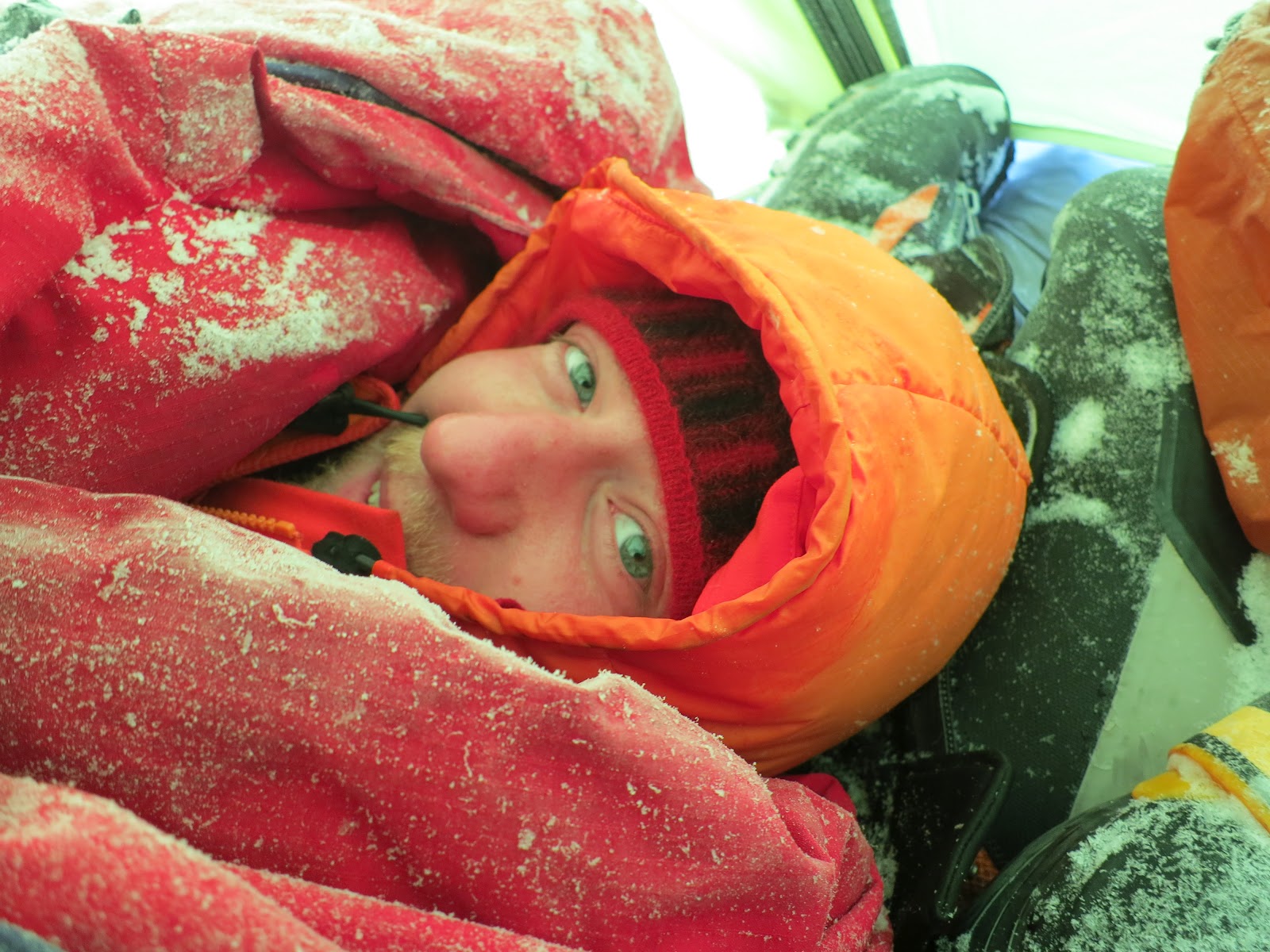
I can't really describe how cold it was except to stay that everything froze, quickly.  It was a big effort for us to stay warm in base camp and it was impossible to stay warm while climbing, alpine bivying or belaying.  The results of the trip are still disappointing and will probably cut even deeper as temps improve and people start sending climbs.

Though a complete failure from a climbing standpoint we did get to spend a week in one of the most beautiful places in the world, explore some potential new lines and see an amazing show of the aurora borealis.

We'll both be back to Alaska... but not in March.

Looks warm in the sun, but I don't think we felt north of zero

Skiing toward Mtn. House from Peak 11,300

What we did in the 10 hours we weren't in sleeping bags

The morning after a miserable night

Flying out of the Ruth Gorge

Thursday, March 01, 2012

The Best Ice Crag in North America

Sorry Banff, you too Cody.  Colorado, you weren't even in the running...  

Lake Willoughby, VT takes its rightful spot as the best ice crag in North America.  Over the length of about two miles ice spills off Mt. Pisgah forming many sustained difficult ice climbs.  There's no contrievance at Willoughby.  Most are independent lines on independent features... and they're proud.  Essentially everything is harder than Wi4 and many are harder than Wi5.  A few of the prouder features fall plumb-line for three rope stretching pitches.  The best part might be the approach: a ten minute stroll up a hillside.

Don't get me wrong, there is more proud climbing within a three hour radius of Banff than there is within three hours of Lake Willoughby but on a crag-to-crag basis its the best and is a lot of room for futuristic lines  on par with anything that the Stanley Headwall or Trophy Wall have to offer.

Given its easy access from urban centers and major international airports, for my money, I'll be back next year for sure...


Andrew about to top-out on a Willoughby Pillar.  

This is the NE's worst year in decades...
and there were still about ten individual lines in.

Cruising up an Underwood Canyon classic...

The NE:  Climb Free or Die!

Sunday, February 12, 2012

The Blue Light Special

Though I had spent most of the past week in a benadryl and illness induced coma, the high pressure system and a couple motivated partners spurred me to consciousness.  Though I ended up drafting on my partners more than usual (especial at camp) still manage to lead a couple solid blocks of leads and together we completed a first winter ascent on a big route in good style.  Surprisingly everything went to plan.  We made it to the bivouac on day one with minimal night climbing, made it to the summit and back down to our packs in the daylight, even the snowmobile ran on our trip out!

Our line followed the buttress between the two prominent couloir systems

Jens has to be the most knowledgeable person for the Stuart Range.  He claims something like 180+ trips into the range... I thought I was bored of the area after maybe 18 trips! Unfortunately the line was nearly devoid of climbable ice being mostly comprised of frozen turf, snowy rock and icy cracks.  It wasn't dry enough to take off the crampons or even holster the tools for a pitch nor was it icy enough to prevent complete dulling of those points.  A small price to pay... gear is meant to be used after all.

The Blue Light Special 
Me scraping up the lower buttress on day one
We climbed in blocks of 2-4 pitches depending on terrain.  On the first day Jens and I both lead a three pitch block which brought us to a rappel and a short traversing pitch to the narrow bivouac ledge.  There is nothing I love more than an alpine bivy where you have to guy the tent to keep it from rolling off a cliff and stay tied in for the entire night... sleeping with a helmet on gives you bonus points.

Pretty awesome exposure on day two... the void looking right back...
 Colin lead out on day two.  His block had some amazing exposure.  I mentioned to Colin that it was like looking into the void, then realizing it was staring back at you (Nietzsche?).  Jens with his vast area experience knew every turn of the upper ridge and ended up taking another block with long simul-climbing sections.  I took the final block which culminated in a complex pitch to the windy summit anchor.
Jens negotiating the hurricane winds at the summit
It's pretty rare that an alpine climb works out... but this one did in essentially every aspect.  Colin even made it to his party in Seattle on day two!

Wednesday, February 08, 2012

The NW Ice Cycle

Just some more local ice that nobody is getting after...

The NW Ice Cycle
Will Gadd made up a Rockies Ice Cycle for his GravSports webpage.  Though ice climbing in the Canadian Rockies is magnitudes greater than the NW, I’ve created the NW Ice Cycle (hint, there is a lot of driving).  As a NW based ice climber I’ve hunted for ice with varying success and still managed to rack up 30-40 days each season.  Though I would never advise that anyone both be an ice climber and live in the NW but if necessary hopefully this will help you enjoy a long season and progress as an ice climber.
There just isn’t a lot of ice in the NW.  Though there are plenty of climbers who rack up double digit days climbing only in the NW you will spend a lot of low quality days on mediocre climbs without sustained difficulties.  If you want to increase the difficulty of what you’re climbing each season you need to climb what we do have: rock.  Establish a drytooling crag on some low quality crag to get used to climbing with your tools and crampons as well as developing some sport specific strengths and skills.
Summer:  Enjoy the good weather and climb lots of rock.  Your rock training will translate to ice skills once it gets cold.  True prophets of the sport will develop a local mixed crag where they can train in the fall and winter when there is no local climbable ice, or when schedule dictates a quick session.
Late Summer/Early Fall:  If you’re keen the serac climbing is in good shape this time of year.    Serac climbing is pretty mundane so most climbers will (should) opt for some crisp fall rock climbing.  If you have a local drytooling crag this is a great time to get a session or two.  If you get comfortable climbing with tools and crampons now, it won’t feel awkward when the early season ice forms.  Regardless, start doing some pull-ups.
October:  There is always a window for early season alpine ice in October in the NW.  Despite the message boards, I have climbed routes in excellent condition when everyone says that “nothing is in.”  Look for high elevation routes (Colfax, etc.) and go for it, there almost always in by mid-month.  This is also an awesome time to head to the Rockies.  If you get there before the snow starts dumping you can climb alpine on the Icefields Parkway or hit one of the many alpine-esque ice routes around Canmore.  Distant areas like the Sphynx in Montana or the Beartooths in Wyoming can be great now too.
November:  This is a month to travel.  Get as many days as you can, that way you’ll be honed when the climbs come in at home.  Bozeman, Cody and Banff should all be in condition by now.  The weather is probably too poor to climb high elevation ice in the NW and there won’t be any low elevation ice.  If atypical weather occurs there will be ice at elevation in the NW and it needs to be climbed.  Between trips you could be climbing at your local mixed crag if you bothered to make one over the summer.  Since you probably didn’t you’re like 98% of NW climbers and are watching the boards religiously while more inspired climbers have already racked up 10+ days.
December - February:  This is basically the  ice season in the NW.  It varies year to year but if you know where and when to climb you can climb almost every weekend these months.  If you get a strong arctic front it is really easy to find local climbs because everything is in on the West side.  Watch the telemetry and look for areas like Leavenworth, Banks Lake and Vantage when the East side is cold but its wet everywhere else.  Strobach Mountain is the best ice climbing in Washington.  In fact, if you consider the Motherload crag it is probably one of the best in North America.  I’ve climbed extensively from Banff, Cody, Colorado, Utah, California and New England and the only crags better than Strobach are Lake Willoughby, VT, the Stanley Headwall, BC and the Trophy Wall, AB.  It’s that good.  In all my trips to Strobach I’ve never even seen another climber, by far the most underused resource in Washington.  If there isn’t a lot of ice formed or it’s a bit warm try climbing the mixed lines on Icicle Creek Road.  It’s Little Bavaria’s answer to Scottish climbing and there are probably 300+ lines along the road that are only touched by a handful of climbers.
March:  Time to travel again.  Banff in March is amazing.  The days are long, the temperatures are moderate, the climbs are fat and the snow has settled.  Take a week because you will have the place to yourself.  Everyone is tired of ice from the winter, but because you’re from the PNW and haven’t seen any ice so far you’ll be stoked and alone on the climbs.  This is a great time to be rewarded for a season of poor conditions and hunting for ice.  Though there are exceptions, in general, the days are too long for climbs to form in the NW but alpine routes are possible and should be considered if conditions permit. 
April-Early Summer:  The ice sticks around for a long time in the alpine.  I know of routes like the NW Couloir of Eldorado getting climbed in July as fat ice routes.  There is no reason that the start of rock season should indicate the end of NW ice climbing.  There are hundreds of fat alpine ice routes waiting for a willing climber who has an imagination (and a bookmark of the Scurlock photo-gallery).  


Wednesday, January 18, 2012

The Land of the Living and of the Dead


After a somewhat intense night at work and the news of a couple recent climbing deaths the reality of morbidity and mortality, for me, is glaringly present.

I deal with death more than most people.  Through working full time in a busy urban emergency room and then engaging in a recreational activity that is not devoid of risk I have first-hand experience with more debilitating injuries and mortalities than I want to think about.

I forget who to attribute this to, but the quote goes that climbing isn’t worth dying for, but it is worth risking dying for.  I won’t argue with that. 

I’ve never been more engaged in the moment than when I’m climbing, but it is not without risks.  Even miniscule mistakes in climbing can have life-altering, or ending, results.  Most climbers don’t acknowledge the actual consequences of their actions.  There aren’t many climbers that who have confronted climbing’s consequences and still climb with a carefree mindset.  I’m not one of those lucky few.  The lessons learned in the past years have taught me how precious and delicate life is.  I now know how lucky I am to have the ability to pursue my passion, and that in the end, my recreational pursuits are meaningless. 

Life is fragile and transient.  Climbing accomplishments are such a small fragment of a persons’ life that they’re practically inconsequential.  Do what you have passion for, but keep it in perspective.  Climbing is amazing but relationships are important.  It’s hard to remember who had what ascent on which peak and during which season but it is a persons’ relationships that endure.

There is a land of the living and a land of the dead and the bridge is love, the only survival, the only meaning. –Thornton Wilder

Tuesday, January 17, 2012

Winter Climbing: Fun, and not just in retrospect

This year winter starts in mid-January.  

Despite an early fall storm and an early start to the ski and ice seasons, January found us with conditions more reminiscent of fall than winter.  Snow was minimal in the alpine leaving many faces dry when typically they would be icy.  In normal years I wouldn't even consider heading for a rock face if I had stable snow and weather in January, but this year is different.  

Taking advantage of the rare conditions, Blake suggested we complete the first winter ascent of Colchuck Balanced Rock West Face.  Aided by a well packed trail due to a Denali training trip (thank you sloglodytes!) and firm neve we had an easy approach on the first day and camped beneath the face.  On the second day we slept in a little to avoid the brutal temperatures completed the climb and started the descent.  We summited just as the sun set and made a hasty descent reaching the car from the summit in just three hours. 

Winter climbing is another game entirely.  The "easy" pitches that collect snow and ice provided the crux and the "hard" steep pitches were mostly straightforward aid, french-free and free climbing.  Blake ripped out a cam while french-freeing on the first pitch setting the tone of the climb and essentially set the tone of the climb.  I found a snow and ice chocked corner that made me dig barehanded in the snow for placements and left me with a rp rat nest anchor.  Blake had an especially exciting snow and turf mantel on the third pitch which would have been made easier by the tools accidentally left at the belay.  The remaining "hard" pitches to the summit were straightforward and devoid of snow.

Blake and I actually had fun while climbing that route.  Winter climbing is rarely enjoyable in the moment and usually in retrospect the miseries are as memorable as the joys.  That we actually enjoyed ourselves should be a statement to the quality of the climbing, the weather and the experience.    

Walking across a frozen Colchuck Lake with CBR W Face in the sun upper left.

Exciting climbing on the "easy" pithces

Jugging the corner
 
Following the crux pitch


Summiting in the twillight

Monday, December 19, 2011

A Long December

Ice climbing is intrinsically motivating.  Unlike rock climbing where you just need to wait for a dry day, ice climbing is all conditions.  You can have ice but wind and not climb.  Ice but its fragile and not send.  Ice but its thin or baked and you back off.  Unlike rock climbing, you cannot pass up an opportunity to climb when it presents itself.  As an ice climber in the PNW... you earn it.  In a period of just over a month I've done three trips and logged just nine days of climbing.  To earn those days I've driven 4,800 miles just to and from the climbing areas.   Totally worth it.

Here's some highlights from two trips to the Canadian Rockies and one trip to Cody, WY.

Mean Green Pitch Four

Animal Rights Activist

Pillar of Pain

Mixed Master (minus the mixed!)

Redman Soars

Wednesday, November 02, 2011

Things That Scare Me


Picking up something heavy, picking up something light and moving quickly that's pretty much what it boils down to.  However, there are certain WODs that are absolutely devastating.  These workouts cause a shiver when I flip through my training log for daily WOD ideas.  At work we use a pain scale for patients to describe pain.  Any one of these equate to a 10/10 on the pain scale.  Here's my top (bottom!) 5.

1:  3000 FY.  3000 meters on the rower in less than 10 minutes.  That means you need to row 1:40/500m for 10 minutes.  I've done this workout probably three or four times and each time I was crushed.  I think I actually spat my lung out the last time I did it.  So far my best is to get less than 200m from hitting the mark....

2:  300 FY.  300 Calories on the AirDyne in less than 10 minutes.  Let's face it, the AirDyne is pure evil.  It saps your energy in mere seconds.  Granted I've only been on it a couple times but the 300FY seems nearly impossible.  I did some 2 min splits on the Air Dyne with 2 minutes rest and not a single one of my splits would have been fast enough to be on pace for the 300FY.  The aftermath? SVT.

3:  Thruster Chicken.  Start with a 45# bar at 2 reps.  Add 2 reps per minutes.  Keep adding reps until you can't complete the reps in that minute.  Thrusters are incredibly metabolic.  Initially you are able to get some healthy rests after your reps.  By the end you will go 4-5 minutes doing constant repetitions of thrusters.  It's hard to keep your head in this one because it is so hard.

4:  Thruster Ladder.  Start with 25 reps at 65# followed by 20 at 85#, 15 at 105#, 10 at 115# and end with 5 at 135#.  I could lift my arms for the better part of week after this WOD.  I haven't had the courage to try it again since.

5:  The Chipper.  When I'm getting ready for a big alpine trip I usually try to shift into some depletion style WODs.  Mountain Athlete used this when they had their push for 90+ minute WODs.  They're grinds so you better load the iPod with a bunch of punk rock because it won't stop.  Here's the one I do a few times prior to a big trip:
1x        250x Step Ups, w/pack (M-35#)

5x        10x Dead Lift (M-185#)
            15x Box Jumps (M-24")
10x      Row 500m
            5x Turkish Getups each arm (M-12kg)
7x        5x Pull ups
            10x Kettlebell Floor Press each arm (M-12kg)
            10x Back Extension
1x        20-15-10-5x
            Curtis P (M-75#)
            Ankles-to-Bar
1x        250x Step Ups, w/pack (M-35#)

Friday, August 12, 2011

Snow Creek Slow Cooker

Psychopath Pitch Crux

Marcus pulls the roof on pitch three.

Marcus jams steep cracks and flakes on pitch four.

Pitch four close up.

The chimney right before the Pressure Chamber.
In the spirit of revisiting the ol' ticklist Marcus and I spent a day this week climbing Hyperspace.  Believe the hype, Hyperspace is good.... real good.  Fully admitting that I'm not a rock hotshot I found the climbing pretty challenging, though with some move specific beta much more obtainable.  First off, expect some physical climbing.  The upper portion of Hyperspace reminded me more of Yosemite style chimneys and bombays than anything I've seen in Washington.  By the time I topped out, I felt pretty beat up.  You don't need to worry about saving your tips because you only use knees, elbows, forearms, ass and back to get up this thing.  It seems like the perfect Yosemite training route.  I'm looking forward to getting back on this and hopefully finishing without feeling like I went ten rounds.

I won't delve into specific beta as Blake's entry on Mountain Project is spot on.  I will say that brassy offsets or rps should work well on the Psychopath pitch but the first 2/3 protects well with tcus.  Also, the pressure chamber is not an offwidth problem its a stemming problem.  Although it must have been pretty humorous going inverted with a thigh jam in a squeeze chimney... at least for one of us.  Blake's suggested grades seemed pretty accurate as well, though I wouldn't call any of them easy for the grade.  Take doubles from green c3 to #3, don't forget some stoppers including rps and possible some offsets.  No #4 needed and you could probably swing it with just one #3.  We took ~12 slings and used almost every sling each pitch.

The Doldrums

Jason on the very fun final pitch of Davis Holland - Loving Arms
The doldrums (aka intertropical convergence zone) is an area of the world where weather systems from the northern and southern hemispheres meet.  The weather convergence produces a region laden with long periods of stagnant windless air that torture wind powered seafarers.  This summer, that's right all 78 minutes of it above 80 F, feels similar to the doldrums.  Long periods of sitting through poor weather in town, working night shifts and a few missed opportunities punctuated with a memorable climb.

I've certainly gotten out far less than I would have hoped this summer.  Partly my diminished activity has been the weather but a new city, job, more distant local climbing and paucity of climbing partners has also played a part.  Despite the circumstances I have revisited a few climbs that I forgot about long ago.

Almost a decade ago my buddy Tim and I got on the Davis-Holland only to get cooked in triple digit heat.  I managed to get back on this route and finish it one evening a couple weeks ago.  I found that nearly every pitch had memorable and exciting climbing.  If you haven't done this climb... do it tomorrow... or at least don't wait another decade!

Wednesday, July 13, 2011

Gato Negro

Mid P3 about to haul, the crux is at top center
Marcus and I settled the score with Gato Negro after having earlier trouble identifying the start of the climb.  It always kills me to go on a "climbing" trip and have the approach be the reason for failure but in the Cascades the incidence is high.  What adds to the insult is that literally every trip report for this route expounded on it being the "easiest approach in the Wine Spires."  It actually is an easy approach but I think the info out there is poor unless you have prior knowledge of the area.  Here's the beta I wish I had:

Approach:  Follow the approach description per Burgandy Col in the Nelson guide.  Once in the basin below the W Face of Silver Star break off the trail toward the R in a gently rising (don't loose any elevation) traverse.  Once on the W side of the mountain, the massif appears to be broken into three sections with two major gully systems (think canyon-esque gully systems).  Gato Negro is in the middle of the three divisions, the Wine Spires are to the L and the other peak of Silver Star on the R.  The climb starts about 50-100ft of a major broad right facing corner and ledge system just uphill of a yellow section of rock.  The second pitch (more on this later) is reached by scrambling up a chimney past a tree to a large sandy ledge.  The bolts on the second pitch may be visible to you if you have great eyes but I couldn't see them until I was on the ledge.  The rock is clean on the second pitch.

Route:  We used the topos included in this post, I think made by the first ascensionists.  Pitch 1 doesn't exist.  Unless the route started via spelunking I have no idea why it was included.  Pitch 2 is rad and shouldn't be missed.  I could see it feeling pretty heads up if it were wet, cold or windy out but if you're not sending this pitch than the rest of the route is likely out of reach.  Pitch 3 is about 55m as opposed to the described 80 ft.  Pitch 4 is exactly as described.  We set up a haul just above the second chockstone (no established anchor just bracing oneself and pulling the pack up) and once again at the top of the pitch which we moved 20ft R to make the haul clean.  Above here the topo was kind of useless.  We followed the line of weakness making sure not to stray too far L and to keep below the crest on the R for two rope-stretching pitches which brought us to an alcove-like area about 20 ft below the crest approximately what is described as the top of pitch 7.  Pitch 8 headed straight up to a roof which was gained by traversing and escaping its L side.  Head back into the L facing corner through a small crux then face climb up and L.  Pitch 9 heads for the crest eventually crossing it to the right.  The 10th pitch is scary.  After clipping a pin move right around the false summit to the true summit.  This move is scary, felt like ~5.8 and definatley had consequences.  A much better way to finish the route would be to climb the stunning  crack to the false summit (you'll know it when you see it) then finish by climbing the crest to the true summit.

Descent:  We had snow which apparently made things much easier.  From the true summit slings we did two single rope raps with a 70m rope skiers left into a major gully systems.  I think you would be screwed if you brought a 60m rope as the stations are not set for this.  Once in the gully go down, there were at least two optional rap stations lower in the gully.  You get deposited about 200m right of the first pitch.

Rack:  1x70m rope.  Stoppers.  2xCams from #1C3 to #2C4.  1xCams from #3-5C4.  If I were to ditch a cam it would be the #4C4 as I placed the #5 on almost every pitch and it was very nice to have on pitch 4


Tuesday, May 24, 2011

Making Adjustments

I've been back from Alaska for a couple weeks now and aside from being extraordinarily busy, I've been trying to make adjustments.  Specifically from a haggard expedition weary alpinist to somebody in shape to do some summer rock climbing.  It has been a slow transition.  Despite every day feeling like a "high-gravity day" I have some hopes to be in shape someday soon.

In the meanwhile, a few shots that I got from Marcus the other day.

Breaking on through.... 

....to the other side:  Digging through the cornice on the Colton-Leech.

Digging for pro on day two... before the storm.

More recently, Yannis getting his first day in at Index.

Marcus and I were also asked to participate in the CiloGear Propoganda Movies the other day.  I wish somebody would have told me that I sound like Jeff Spicoli.