Pages

Friday, May 03, 2013

We Were Warriors Once and Young?

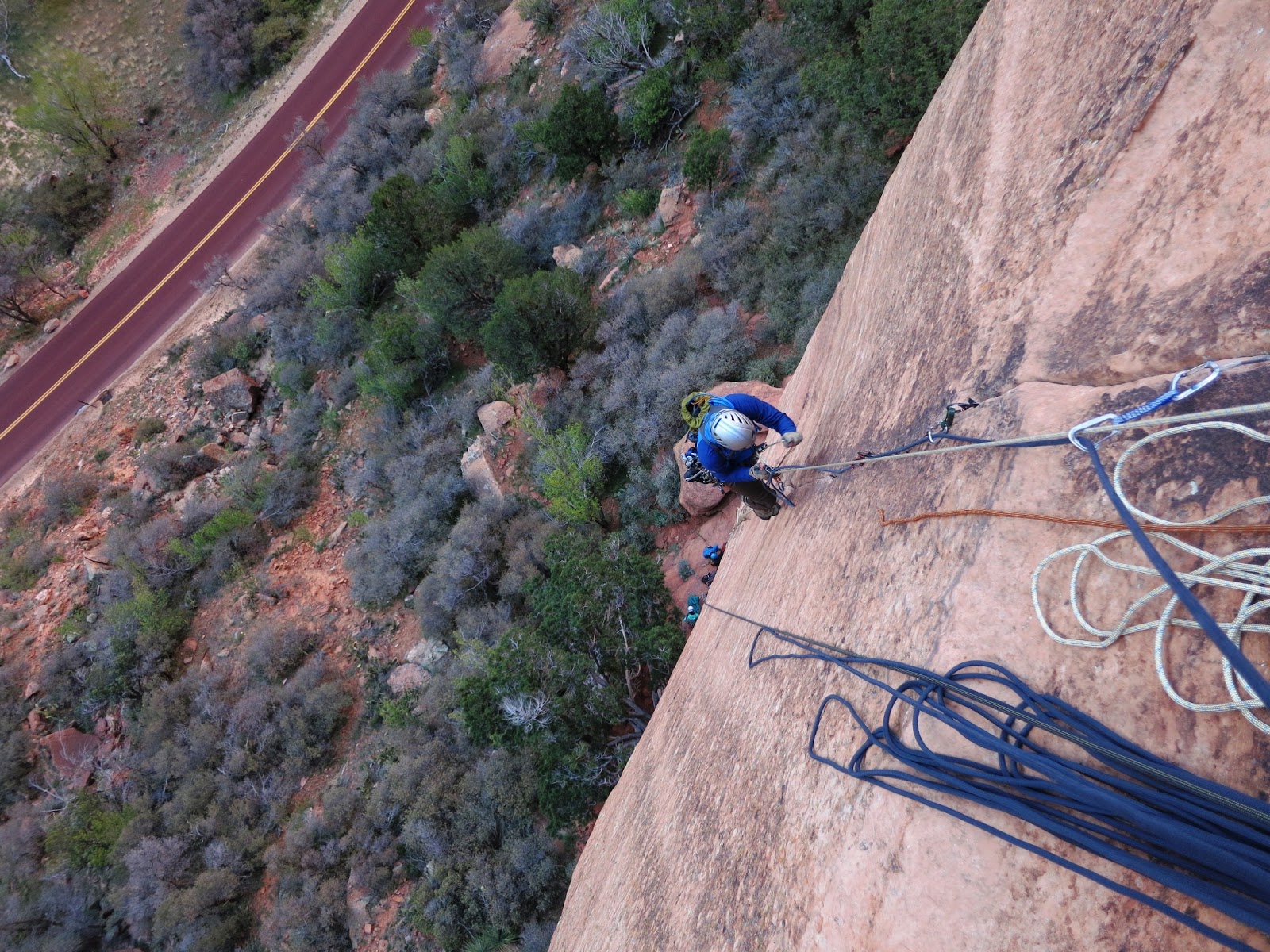
The Rock Warrior:  Probably the first time I could be called that.  I'm here just above the short 5.10 crux with 60ft ground fall potential  Each pitch of this route was memorable (read 30+ft runouts).  I can't deny the Adventure Punks had style...
Dreaming of Wild Turkeys.

Rodney and I finally connected for some Red Rocks climbing.

Rodney has been hassling me for years to come down and explore the amazing climbing in RR.  It took me moving next door to make the trip happen.

Resolution Arete, in particular is the carrot that he has dangled to tempt me into the trip.  We got the route done in a a casual (read:  limited headlamps) day last week.  I can't say the climbing was good and I'm not planning on a repeat ascent, but it was a true adventure.  The climbing was pretty sustained at 5.10 despite what the topo states and the 10d pitch was exciting with the limited rack we carried.

All-in-all this route went pretty well for us.  We only lost a half-hour or so in the morning looking for the route, and maybe an additional hour looking for the descent.  I (not so much Rodney) opted for a lightweight rack (taking just singles and few doubles in finger sizes.  Considering there is exactly one piece of fixed gear on this route, a few extra cams would have sped things up.

Resolution Arete is a full-on desert rock'aneering adventure.  Even though I'm a novice to Red Rock, I don't think you've climbed at RR unless you've done this route.

Here is a video I made of our ascent:  Resolution Arete Video.

Sunday, April 21, 2013

Stepping Off the Ground


BJ and I connected over the past week to climb in his local crag, Zion.  We had originally planned to head up Moonlight Buttress but learned through the grapevine that five permits were given to climber's all planning to climb that route on our chosen day.

Plan B:  Touchstone Wall.

Though it lacks the aesthetic prow that MB takes, Touchstone has some pretty classic climbing.  A couple of initial aid pitches reminded me how much I prefer free climbing to aid climbing.  This point was driven home again as I tried to free climb 11- with etriers, jugs, daiseys, and static line hanging from my harness.

We ended finishing the climb in a casual day and rapped the descent route.  I would highly recommend the descent route vs. rappeling the route because it is very fast and straight-forward.  It took us 1h15min from the top of the 5.7 sport pitch (pitch 9?) to climb the ridge and descent the descent gully.  I'd expect it would take us almost twice as long to rappel the route proper.  Additionally, given that this route is all enjoyable free-climbing after the second pitch, doing this route as a fix-and-fire would probably make the free climbing more enjoyable without all the extra aid gadgetry.  


Thursday, March 07, 2013

And Now For Something Completely Different...

Life has drawn me away from the NW to the desert of Southern Nevada.  I can't say that I could have planned it this way, but let's say I'm embracing the change.  While in the NW, I was primarily focused on alpine climbs, manipulating my life to exploit narrow window of climbable weather and largely training for climbing.

While my passion is still alpine climbing (of the ice and mixed variety), the new focal point of my climbing is going to be sunnier, dryer and considerably warmer.  I have successfully avoided learning how to climb difficult rock climbs, as least by my standard, throughout my career through my constant pursuit of alpine and ice objectives.  This unforeseen move to Las Vegas will hopefully fill in some blanks in my repertoire and hopefully translate into gains in the mountains and on ice or mixed.

Change is hard.  I'm already missing the ability to connect with my usual climbing partners and charge after windmills   I'm sure I'll miss the winter routine of scouring NOAA for weather forecasts and, as strange as it may sound, the long drives to Montana, Wyoming and Alberta for ice trips.

Breaking the routine may prove to be the impetus I need to overcome some of the hurdles I consistently face.  A lot remains to be seen.  At the very least I'm embracing this change.  I'm resolved to develop my climbing in whatever ways I can from the Las Vegas area, even if that means I move away from traditional goals.  It looks like I'll be trading ice axes and crampons this Spring for what I've always disdained as...

...flip flops and bolts.

You can't find this in the NW...

Wednesday, February 20, 2013

Reality Bites


In what will surely be the final trip of this abbreviated and mediocre ice season, Marcus and I once again ventured north to the Canadian Rockies.  We had an absolutely perfect forecast the morning we left.  However, by that evening the avalanche danger had picked up and two of our three climbing days were predicted to have substantial snow.  That's how it goes in the Rockies...  Thankfully, even though snow augmented our plans, we still had decent temps and could get on more protected routes.

Day one involved a run up Kitty Hawk and a recon of the Stanley Headwall for an attempt the following day.  Personally, I never considered the routes on the SH as possible objectives (other than Nemesis or Suffer Machine which are moderate by comparison).  Actually getting up near the routes and sussing them out in my head really opened up some doors and I'm ready to step through them.... but not until avy conditions stabilize.  We encountered a scary snow pack, turned tail and ran home.

The previous day we watched a couple Quebecois climbers on FR.  I can only assume they packed along a couple sets of brass balls on their rack to even contemplate that approach with current snow conditions... yikes.  In a completely unsurprising move, we ended up at Haffner and Marcus ticked Fight Club which he had been quite close to sending for a while.

The final day ended up being quite snowy but we managed to push the Subaru into the ghost for some low hanging fruit in the Valley of the Birds.  I can't say I will ever plan to go to the VOTB again, but with the 10-minute walk, its more than likely I will end up there at some point.  FWIW the mixed routes at the Bird Cage are not worthy...

Here's to a short season.  I can't say I climbed anything that great or even much of anything at all.  It was at times disappointing and frustrating and at others rewarding to get on some rare-formers.  At the very least I ended the season already excited for the next year... so how bad could it be?

Thankfully Kitty Hawk is NOT where Marcus was first to fly...

The Stanley Headwall with French Reality on R

Friday, February 01, 2013

Every Dog Has Its Day

Had a quick trip to, ahem, Washington, for some ice climbing this week.  I think we nabbed the end of the good conditions (and I use that term loosely) having good days at Dog Dome in Leavenworth and at Banks Lake.  Overall conditions were fairly bleak.  Though there were some rarely formed climbs in, they were probably tougher than they would be in a good year.  Regardless we had fun and climbed several pitches each day.  It was certainly nice to not need to venture so far afield to go climbing...


Tuesday, January 22, 2013

Doing the same thing, expecting different results

Haffner:  The Perpetual Checkdown Day.
Easy cragging...


I am part-way into an abbreviated ice season with an already diminutive amount of quality climbing.  Over the past two seasons I’ve climbed four quality ice routes:  Unholy Baptism, Redman Soars, Mean Green and Goatsbeard.  In the alpine realm it is a wash with a few quality local ascents and one solid trip to Alaska balanced against a lot of waiting, taking the tools for a walk and one lousy trip to Alaska.  I’m climbing the same grades on rock today as I did three-years ago.

After doing a cost-benefit analysis, it just doesn’t add up.  I’ve invested untold amounts of time, effort and money over the past three-years but haven’t seen the benefits.  That being said, I have had a lot of fun days repeating routes, mixed climbing, cragging or alpine climbing on easily tackled objectives. 

I’ll admit it; climbing isn’t just about having fun for me.  For me a big part of climbing is pushing perceived boundaries, working toward goals and doing things that I previously thought impossible.  There are easier ways to have fun than climbing which often, is at best, only fun after the fact.  Though I suppose diminishing returns should be expected, the balance is in the red. 

I’m sure I’m to blame. 

I haven’t changed my modus operandi in years though I haven’t progressed in essentially any facet of my climbing in the same period.  I climb the same rock, ice and mixed grades as I did a couple years ago and I’ve made no changes.  I convinced myself that people who were progressing or were having more successful days in the alpine were just lucky or in a better position.  Either may have been true at times but still I did nothing to change my station.  I have fallen into a rut and somehow I had convinced myself that I could keep doing the same things and expect different results. 

People make difficult choices all the time and those regarding climbing amount to the easiest among these decisions.  I’ve made choices that have pointed me away from maximizing climbing and I don’t regret them.  The dilemma is not about regretting the life decisions I’ve made.  The problem is that I have failed to allocate the time and effort I have available toward climbing in a way which is gratifying and reinforces what I love about this sport.

I’m breaking the cycle this year and I’m going to try something different.  I am refusing to take the consistent check down days and I am going to work harder to ensure I have higher percentage alpine days even if that means fewer days in the alpine and more at the crags.  I need movement and challenge somewhere even if that means climbing fewer days or climbing more rock and less ice (or visa versa).  I need movement and change.  At the very least I need different results wherever they take me…

Thursday, January 17, 2013

Hunting Goat

This past week is possibly the first time that the route Goatsbeard in Mazama, WA formed as a complete ice climb.  The first ascent involved rock climbing and direct aid to reach the start of a partially formed pillar on the second pitch.  Needless to say it was in more favorable condition this week with mostly fat, soft ice.

Rumor has it that Goatsbeard may have received a second and aid-less ascent somewhere in the interim between the first ascent and last weekend when its first repeat was claimed.  That party also claimed it to be the longest continuous waterfall ice in North America at 420m.  We climbed the route in five pitches with a 70m rope.  I might be rusty and perhaps I forgot to carry a zero but that doesn't seem to add up to anymore than 350m. After climbing four rope-stretching pitches and one 50m pitch we estimate Goatsbeard's length as approximately 320m (given its wandering nature and use of the rope in anchors).  

Regardless, there is no prize for second place (or fifth or sixth in our case) and there are much longer climbs but not in Washington.  While it is one of the better climbs at the grade and length that I've climbed what makes it unique is because its local and elusive.  I feel pretty lucky to be on one of the half dozen or so teams that have completed this route.

Blake getting ready to "bring the psyche" at the base.

Looking down the first pitch at a cave on left side of first crux pillar.

Blake leading out on the third pitch.

"Crushing mind demons" on the last pitch.

Follow ice to trees, go back down the same way.
The climb as we did it:
P1 70m to a belay cave on left of crux pillar.  
P2 50m to a rock belay on large snowfield to right of climb.  
P3 70m to snowfield and belay in alcove on the right.  
P4 70m to a cave belay to the left.  
P5 70m to the trees.

Tuesday, September 18, 2012

The First Day of School

Colin and I had our first day of big wall school as it were on the University Wall in Squamish.  In addition to being our introduction to wall climbing systems, it was also my vertical bachelor party.  Thus, we took along some excess weight mostly in the form of beer.  We learned a lot about how to rig a haul, haul the pig, set up and live on ledge.

More than anything I learned that I like free climbing a lot more.  Don't get me wrong, I completely look forward to spending some time on El Capitan climbing routes that largely go free with long sections of aid or even some of the easier aid routes.  However, considering that I already don't have enough time to climb, I'm not convinced that I want to spend any of it learning to hang from increasingly sparser and poorer protection.  That being said I do enjoy that aid climbing puts you in amazing positions and with all the luxuries and comfort of the ground.  It's quasi-vertical camping.

Slab-hauling to the base of the U-Wall

Colin cleaning the first pitch... looks like a better free pitch than aid!


You can tell you're new at wallin' when you take a picture of easy hook placements....

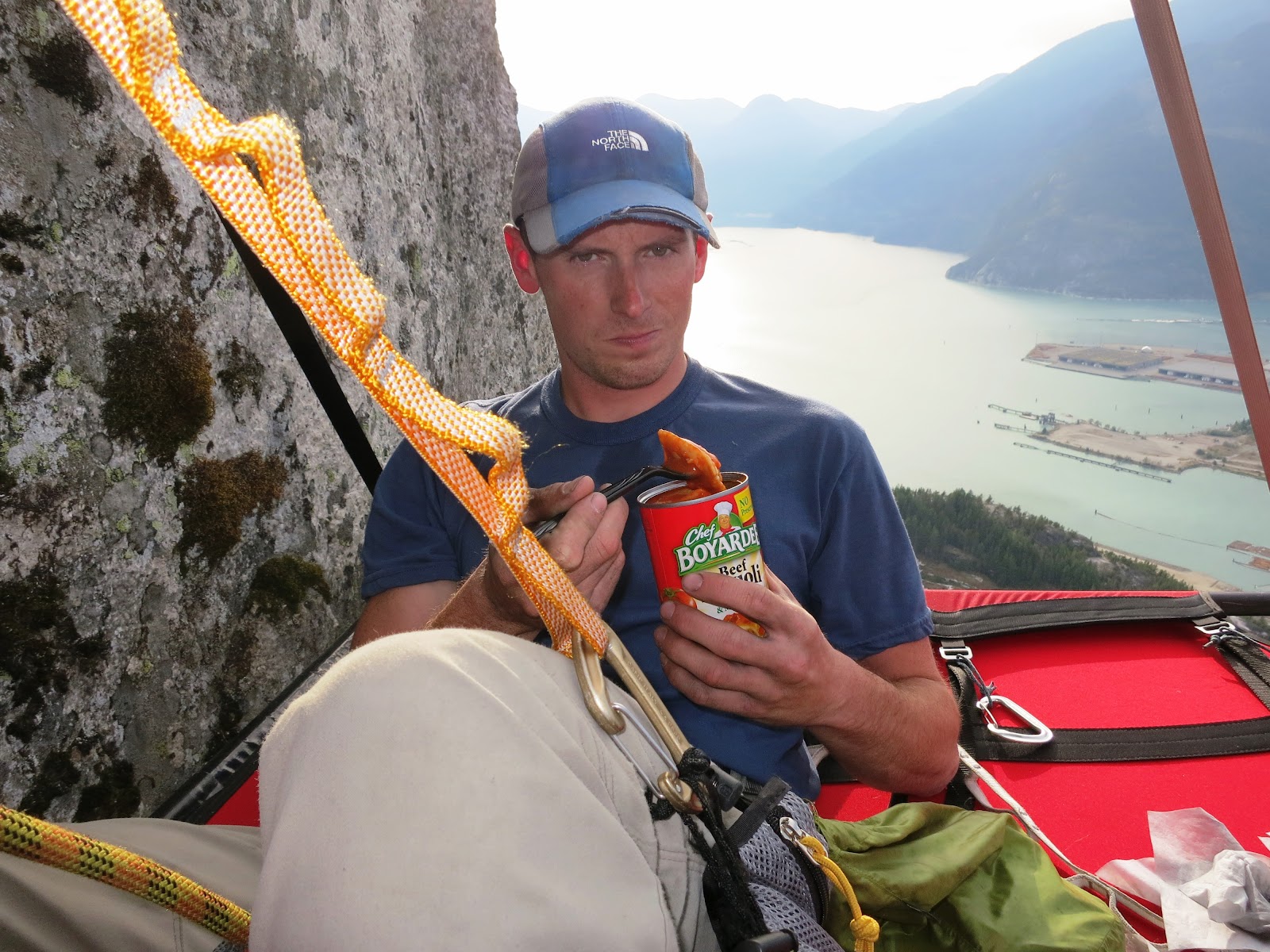
Big Wall cuisine


Wednesday, September 05, 2012

Lessons From History


After repeating the Beckey-Chouinard on South Howser Tower I spent some time looking through pictures of my original ascent.  I'm struck by this picture from my original ascent which was taken at the base as we changed into rock shoes.  Specifically, I'm amazed by how big this pack is (35L and filled to the brim).  What could I possibly have taken?  More specifically, what should I have left out?  To answer this question I'm going to compare and contrast the two ascents packing list.

2005:  Full shank climbing boots, ice axe, crampon (half set), camelback, food, rain pants and jacket, puffy jacket, soft shell jacket.
2012:  Approach shoes, ice axe, crampon (half set), camelback, food, rain pants and jacket, puffy jacket, windbreaker, sil tarp or sleeping bag.

Looking about the packing lists, is I actually brought MORE gear on the second ascent but somehow brought a pack only half the size.

I'm sure most of us have passed somebody on the trail with a massive pack for a short trip and thought "What did they pack?"  Here's my theory:  It's not the necessary items that make the difference its all the non-essentials that alter pack weight and size.  The massive caveat being that doing without a "necessary" item will obviously make a difference.  For example I brought approach shoes instead of boots which saved space and weight, and worked given the conditions. Also, we could have done without the sleeping bag and sil-tarp for our planned bivy but would have frozen in the predicted rain.

For a 1-1.5 day climb, aside from basic clothing and whatever gear you're forced to carry over, how much junk could you possibly need?  You'll need a couple liters of water (plan on being dehydrated by the end), about 8-10 bars, headlamp, gloves and hat if its ends up being colder than anticipated, blue bag for mid-route deuce, 20 feet of rap tat and that's about it.  I would advocate for leaving the ten-essentials at the base and only taking what is needed for upward and downward progress and survival for the interim between the two.  Streamline your packing by taking care of tasks ahead of time.  Instead of bringing sunscreen make sure to lather up in the morning and leave it in camp.  Forget the extra batteries, make sure to put a fresh set in before every big climb.  In fact forget anything for which "extra" is written down on the packing list.

A good objective is use everything that you bring on a route and when you get down to the base and say you've done that, then you know you packed well.

Saturday, August 25, 2012

Onsite Rappeling in the Bugaboos

With Rob in from Chicago for just over a week, we knew that we had a narrow window to work with.  Typical weather in the Bugaboos leaves something to be desired.  Thankfully for us, Rob's airline itinerary coincided with the 48 hours of good weather needed to get us into the range, on to- and off-of a big route with only a short dousing.  

Though, I'd climbed the Beckey-Chouinard years previously I have always wanted to return in part because its an amazing route and also because, at the time, the route had pushed me to my limit and our "in-a-day" ascent became a 26 hour suffer-fest.  Rob and I wanted to improve on that experience by going faster, lighter and climbing in better style.

We planned for another single day push, but clouds rolled in during the night causing us to rethink our plan and hit the snooze button.  Unfortunately (fortunately?) the dawn broke clear and we decided to saunter over to East Creek, bivy and climb the next day after some predicted evening rain.  In the end, our desire to climb trumped our desire for comfort and we headed out just after midday with small packs, a down sleeping bag and a sil-tarp.  

After making great time in the waning daylight, we turned our headlamps on at the final pitch and made it to the summit an hour or two later.  Unfortunately on the rappel we blew the onsite and were unable to find the descent route that night.  For future descensionists the first rappel goes skier's right!

We tossed down the ropes, pulled out the sleeping bag and settled in for a few hours until first light illuminated the descent and we made our escape.  

Despite having to bivy for a few hours, I'm pretty happy with our style on this route as we expected to bivouac having started so late in the day.  Additionally the weather held out just long enough that we only got rained on during the walk back to the route's base and our packs.  Being on the receiving end of weather induced failure, it was satisfying to watch several parties rap the route that day in the rain knowing that we had just capitalized on the narrow weather window.

The Beckey-Chouinard

Beautiful 5.9 corner mid-route
Rob following before the ledges at about half-height

The fatigue setting in...
Rob showing his respect to Scotland

Tuesday, July 24, 2012

COG (Climb of Girth)

Until recently I have been unaware of the latest entry into the climber's vernacular:  MOG.  For those of you not learned in climber speak, a MOG is a man of girth... we'll apparently this last weekend was a COG (climb of girth).  Colin and I teamed up for the Girth Pillar and had a great if not adventurous time.  We made good time throughout our climb even considering the two pairs of boots, axes and crampons that the follower was force to carry.
There isn't any section on this route that is amazing but the entire package makes it worth climbing.  Many (most?) people seem to approach via the N Ridge bypass which makes it a considerably shorter climb and easier due to lack of ice climbing terrain and required gear.  I'm glad we climbed it via the Ice Cliff Glacier but it was a lot of work.  We encountered three pitches on the Ice Cliff that we felt were belay worthy, but if you had two tools you likely would just solo through (but then you have to carry two tools).
Our excitement factor was multiplied by a surprisingly active Ice Cliff Glacier and a rock fall incident that destroyed one backpack and put two core shots in our lead line.  Misadventures aside we rallied and finished the climb in good time and were still friends at the end of the story.


Climbing down low on the L to R leading ramp to the Girth Pillar

Colin jugging up to our hanging belay on the Girth Pillar

Me leading the 5.11 section on the second pitch


Thursday, July 19, 2012

Adventures in Meth-opotamia

The climbing at the Index Town Walls is perhaps the biggest draw to the Sky Valley aside from the meth cookers.  The climbing can get you just as high... without all those bugs crawling under your skin.

Jason and I ran out for an after-work session up at the upper town wall.  It had been about ten years since I'd been on Heaven's Gate which is a fantastic sport multipitch line about fifty yards left of Davis-Holland.  There isn't a bad section on this route and developers bolted it very well (albeit a tad conservatively in some sections).  Bring 14 draws, leave the trad rack hanging at the first belay and a single 70m rope will get you up and down.  In my mind this route is on par with Davis-Holland an ought to have a line at the bottom.  

Jason climbing Lamplighter (Heaven's Gate's first pitch).

Jason nearing the top of the second pitch.

Jason on the third pitch.  The route finishes up the obvious
double roofs above with a definite crux at the second roof.

Sunday, July 01, 2012

Come to Washington Pass for the Crack

This summer started out right with a great day out and a route scratched from the tick list.  Though Washington Pass has some of the best alpine climbing in the state, I've actually climbed there very little.  Though low lying fruit abounded, Chris and I opted to try Freedom Rider an entirely free route on the E Face of Liberty Bell.  

There should be a line at the base of this route.  After two easy and somewhat loose pitches one reaches the crux third pitch.  The third pitch is either a reportedly scary and runout 10d or an 11b offwidth.  We chose the offwidth and days later I still look like I got attacked by a bear.  

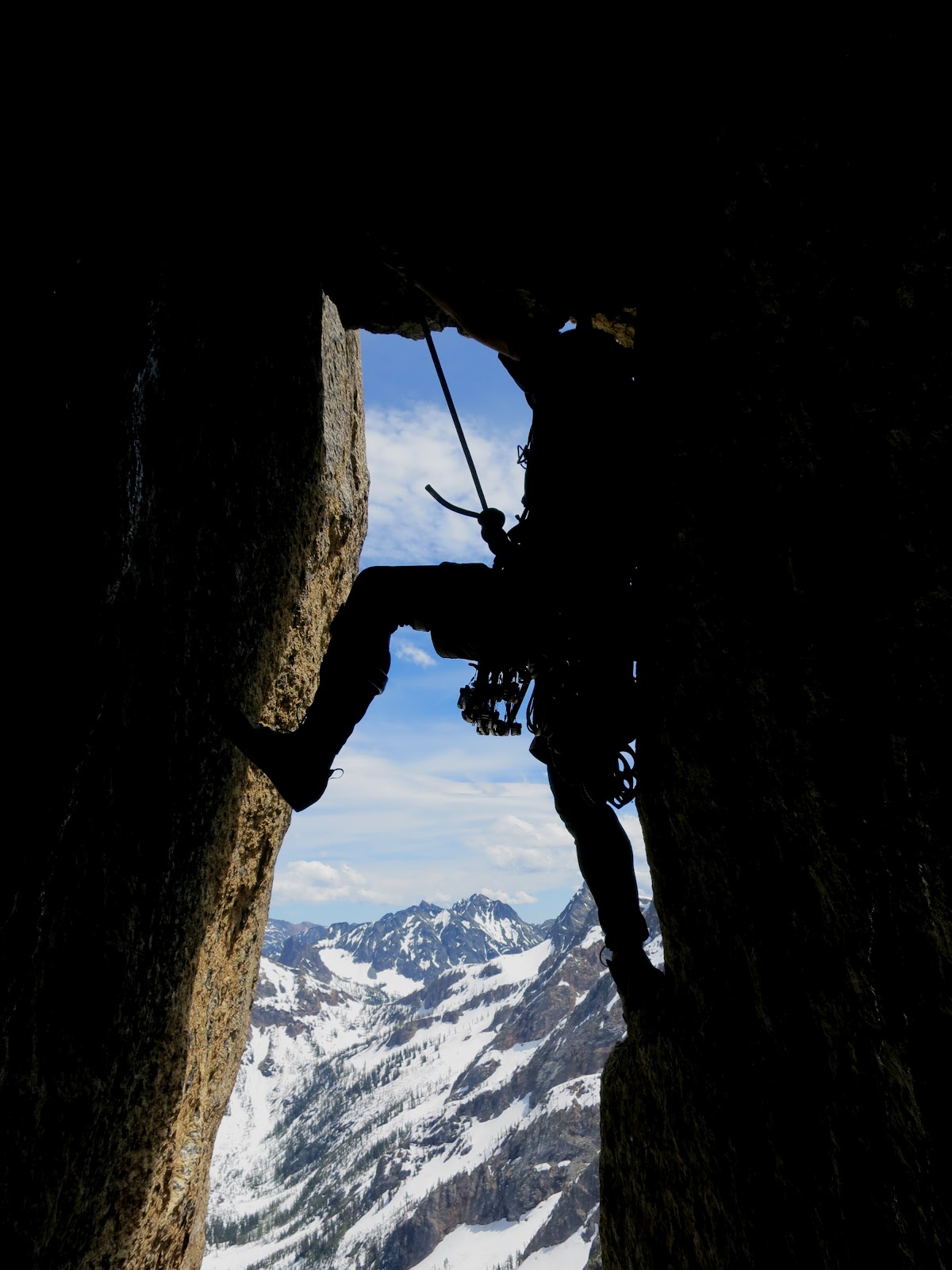
After the crux pitch, the route briefly joins the Liberty Crack route where it surmounts the aptly named "rotten block" then heads off right.  A massive chimney feature leads into Medusa's Roof which is one of the most unique pitches I've ever climbed.  Back-to-foot chimney moves lead horizontally out from the belay then overcome a massive chockstone and follow a splitter crack to the belay.

It was fun to climb with Chris who has spent many days climbing at Washington Pass and had previously climbed all the pitches on Freedom Rider beyond the rotten block.  

Best of all, though we carried rain gear in our packs all day, the rain held off until the precise moment we reached the car.  Nothing better than hitting a weather window perfectly... makes going to work all weekend, in the rain, more bearable.

Chris on the approach (if you can call a 30-min stroll and approach!)

A little spice at the end of pitch two, face climbing between cracks.

Chris about to pull over the chockstone on Medusa's Roof. 

Even the townspeople came out to see...


Friday, March 30, 2012

Too Cold to Fire

Colin and I headed to Alaska just after the official start of Spring.  We were the first climbing party to fly in this season (other than the winter big-mountain soloists).  We didn't get anything done besides taking our gear for a walk a couple times... unfortunately it took two airplane rides and a car rental to get our gear to the glacier so we could walk it.

I can't really describe how cold it was except to stay that everything froze, quickly.  It was a big effort for us to stay warm in base camp and it was impossible to stay warm while climbing, alpine bivying or belaying.  The results of the trip are still disappointing and will probably cut even deeper as temps improve and people start sending climbs.

Though a complete failure from a climbing standpoint we did get to spend a week in one of the most beautiful places in the world, explore some potential new lines and see an amazing show of the aurora borealis.

We'll both be back to Alaska... but not in March.

Looks warm in the sun, but I don't think we felt north of zero

Skiing toward Mtn. House from Peak 11,300

What we did in the 10 hours we weren't in sleeping bags

The morning after a miserable night

Flying out of the Ruth Gorge

Thursday, March 01, 2012

The Best Ice Crag in North America

Sorry Banff, you too Cody.  Colorado, you weren't even in the running...  

Lake Willoughby, VT takes its rightful spot as the best ice crag in North America.  Over the length of about two miles ice spills off Mt. Pisgah forming many sustained difficult ice climbs.  There's no contrievance at Willoughby.  Most are independent lines on independent features... and they're proud.  Essentially everything is harder than Wi4 and many are harder than Wi5.  A few of the prouder features fall plumb-line for three rope stretching pitches.  The best part might be the approach: a ten minute stroll up a hillside.

Don't get me wrong, there is more proud climbing within a three hour radius of Banff than there is within three hours of Lake Willoughby but on a crag-to-crag basis its the best and is a lot of room for futuristic lines  on par with anything that the Stanley Headwall or Trophy Wall have to offer.

Given its easy access from urban centers and major international airports, for my money, I'll be back next year for sure...


Andrew about to top-out on a Willoughby Pillar.  

This is the NE's worst year in decades...
and there were still about ten individual lines in.

Cruising up an Underwood Canyon classic...

The NE:  Climb Free or Die!

Sunday, February 12, 2012

The Blue Light Special

Though I had spent most of the past week in a benadryl and illness induced coma, the high pressure system and a couple motivated partners spurred me to consciousness.  Though I ended up drafting on my partners more than usual (especial at camp) still manage to lead a couple solid blocks of leads and together we completed a first winter ascent on a big route in good style.  Surprisingly everything went to plan.  We made it to the bivouac on day one with minimal night climbing, made it to the summit and back down to our packs in the daylight, even the snowmobile ran on our trip out!

Our line followed the buttress between the two prominent couloir systems

Jens has to be the most knowledgeable person for the Stuart Range.  He claims something like 180+ trips into the range... I thought I was bored of the area after maybe 18 trips! Unfortunately the line was nearly devoid of climbable ice being mostly comprised of frozen turf, snowy rock and icy cracks.  It wasn't dry enough to take off the crampons or even holster the tools for a pitch nor was it icy enough to prevent complete dulling of those points.  A small price to pay... gear is meant to be used after all.

The Blue Light Special 
Me scraping up the lower buttress on day one
We climbed in blocks of 2-4 pitches depending on terrain.  On the first day Jens and I both lead a three pitch block which brought us to a rappel and a short traversing pitch to the narrow bivouac ledge.  There is nothing I love more than an alpine bivy where you have to guy the tent to keep it from rolling off a cliff and stay tied in for the entire night... sleeping with a helmet on gives you bonus points.

Pretty awesome exposure on day two... the void looking right back...
 Colin lead out on day two.  His block had some amazing exposure.  I mentioned to Colin that it was like looking into the void, then realizing it was staring back at you (Nietzsche?).  Jens with his vast area experience knew every turn of the upper ridge and ended up taking another block with long simul-climbing sections.  I took the final block which culminated in a complex pitch to the windy summit anchor.
Jens negotiating the hurricane winds at the summit
It's pretty rare that an alpine climb works out... but this one did in essentially every aspect.  Colin even made it to his party in Seattle on day two!

Wednesday, February 08, 2012

The NW Ice Cycle

Just some more local ice that nobody is getting after...

The NW Ice Cycle
Will Gadd made up a Rockies Ice Cycle for his GravSports webpage.  Though ice climbing in the Canadian Rockies is magnitudes greater than the NW, I’ve created the NW Ice Cycle (hint, there is a lot of driving).  As a NW based ice climber I’ve hunted for ice with varying success and still managed to rack up 30-40 days each season.  Though I would never advise that anyone both be an ice climber and live in the NW but if necessary hopefully this will help you enjoy a long season and progress as an ice climber.
There just isn’t a lot of ice in the NW.  Though there are plenty of climbers who rack up double digit days climbing only in the NW you will spend a lot of low quality days on mediocre climbs without sustained difficulties.  If you want to increase the difficulty of what you’re climbing each season you need to climb what we do have: rock.  Establish a drytooling crag on some low quality crag to get used to climbing with your tools and crampons as well as developing some sport specific strengths and skills.
Summer:  Enjoy the good weather and climb lots of rock.  Your rock training will translate to ice skills once it gets cold.  True prophets of the sport will develop a local mixed crag where they can train in the fall and winter when there is no local climbable ice, or when schedule dictates a quick session.
Late Summer/Early Fall:  If you’re keen the serac climbing is in good shape this time of year.    Serac climbing is pretty mundane so most climbers will (should) opt for some crisp fall rock climbing.  If you have a local drytooling crag this is a great time to get a session or two.  If you get comfortable climbing with tools and crampons now, it won’t feel awkward when the early season ice forms.  Regardless, start doing some pull-ups.
October:  There is always a window for early season alpine ice in October in the NW.  Despite the message boards, I have climbed routes in excellent condition when everyone says that “nothing is in.”  Look for high elevation routes (Colfax, etc.) and go for it, there almost always in by mid-month.  This is also an awesome time to head to the Rockies.  If you get there before the snow starts dumping you can climb alpine on the Icefields Parkway or hit one of the many alpine-esque ice routes around Canmore.  Distant areas like the Sphynx in Montana or the Beartooths in Wyoming can be great now too.
November:  This is a month to travel.  Get as many days as you can, that way you’ll be honed when the climbs come in at home.  Bozeman, Cody and Banff should all be in condition by now.  The weather is probably too poor to climb high elevation ice in the NW and there won’t be any low elevation ice.  If atypical weather occurs there will be ice at elevation in the NW and it needs to be climbed.  Between trips you could be climbing at your local mixed crag if you bothered to make one over the summer.  Since you probably didn’t you’re like 98% of NW climbers and are watching the boards religiously while more inspired climbers have already racked up 10+ days.
December - February:  This is basically the  ice season in the NW.  It varies year to year but if you know where and when to climb you can climb almost every weekend these months.  If you get a strong arctic front it is really easy to find local climbs because everything is in on the West side.  Watch the telemetry and look for areas like Leavenworth, Banks Lake and Vantage when the East side is cold but its wet everywhere else.  Strobach Mountain is the best ice climbing in Washington.  In fact, if you consider the Motherload crag it is probably one of the best in North America.  I’ve climbed extensively from Banff, Cody, Colorado, Utah, California and New England and the only crags better than Strobach are Lake Willoughby, VT, the Stanley Headwall, BC and the Trophy Wall, AB.  It’s that good.  In all my trips to Strobach I’ve never even seen another climber, by far the most underused resource in Washington.  If there isn’t a lot of ice formed or it’s a bit warm try climbing the mixed lines on Icicle Creek Road.  It’s Little Bavaria’s answer to Scottish climbing and there are probably 300+ lines along the road that are only touched by a handful of climbers.
March:  Time to travel again.  Banff in March is amazing.  The days are long, the temperatures are moderate, the climbs are fat and the snow has settled.  Take a week because you will have the place to yourself.  Everyone is tired of ice from the winter, but because you’re from the PNW and haven’t seen any ice so far you’ll be stoked and alone on the climbs.  This is a great time to be rewarded for a season of poor conditions and hunting for ice.  Though there are exceptions, in general, the days are too long for climbs to form in the NW but alpine routes are possible and should be considered if conditions permit. 
April-Early Summer:  The ice sticks around for a long time in the alpine.  I know of routes like the NW Couloir of Eldorado getting climbed in July as fat ice routes.  There is no reason that the start of rock season should indicate the end of NW ice climbing.  There are hundreds of fat alpine ice routes waiting for a willing climber who has an imagination (and a bookmark of the Scurlock photo-gallery).